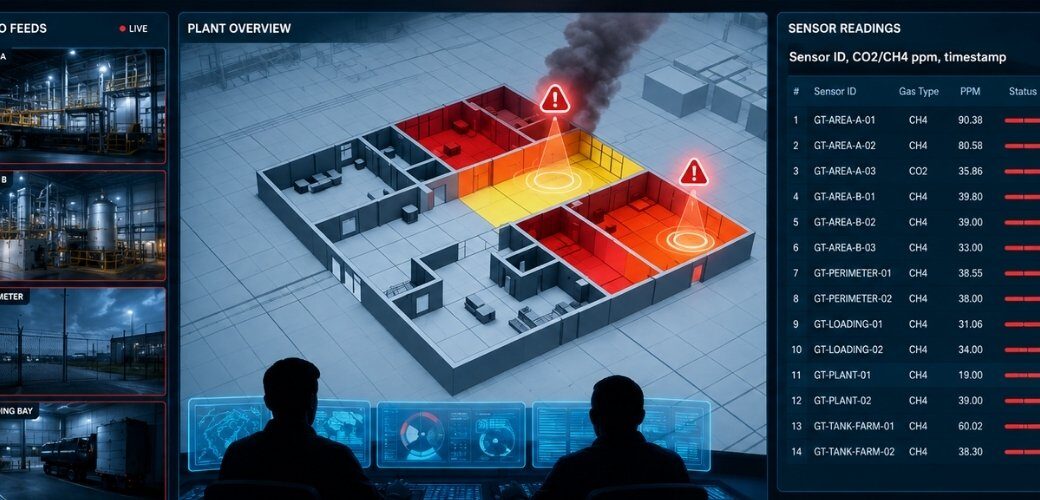
Cameras and sensors are everywhere. But in too many security operations those devices only create noise: thousands of alerts, manual clip review, and long investigations that eat time and budget. The technology is not the problem, the way we use it is. The difference between wasted capability and measurable impact is a simple one: a framework that turns detection into validated incidents, prioritized recommendations, and auditable actions.
Why this matters now.
Security teams are under pressure on three fronts: rising threat complexity, tighter regulatory scrutiny, and leaner budgets. Boards ask for defensible risk reduction. CISOs must show ROI. Security operation center(SOC) teams face alert overload and burnout. AI promises to help, but without a clear path it becomes another vendor feature that underdelivers. The real opportunity is to stop treating AI as a checkbox and start treating it as a staged capability you build and measure.
A Practical Five-Step Path to Intelligent Security:
- Detect: Systems reliably sense events (motion, door forced, perimeter breaches). This is the baseline: if you can’t detect reliably, nothing else works.
- Describe: Alerts are auto classified and packaged with key clips, timestamps and short summaries. This saves operators hours of report writing.
- Explain: Correlate video, access logs, intrusion and intercom so incidents are validated before people move. This is the inflection point where operational gains start becoming business value.
- Recommend: Use historical data and probabilistic models to forecast hotspots and device failures, and recommend prioritized interventions.
- Act: Execute pre-approved runbooks automatically for routine responses while preserving full audit trails and human approval for high-risk actions.
Why Level 3 is the game changer?
Many organizations reach Levels 1-2: they detect and generate summaries. But Level 3: Explain is where the view clears. Correlation across systems reduces false dispatches, raises confidence, and produces packaged evidence that investigators and auditors can trust. In short, you stop spending time proving what happened and start spending time preventing it from happening again.
Business outcomes you can expect when the path is followed deliberately, returns are measurable and compound as you climb:
- Cost reduction: fewer unnecessary guard call outs and lower overtime.
- Faster investigations: evidence assembled in minutes, not hours.
- Reduced risk: earlier containment, fewer repeat incidents.
- Operational scale: one SOC can cover more sites without linear headcount growth.
- Compliance readiness: automated retention, traceable decisions, and auditable runbooks.
How to get started:
- Assess per use case, not in aggregate. You may be Level 3 in access control and Level 1 in perimeter analytics, treat them differently.
- Prioritize quick wins: pick high‑impact, high‑readiness use cases where data and integrations already exist.
- Invest in data readiness: structured event metadata, timestamps, normalized location IDs, and documented APIs make cross‑system correlation possible.
- Define governance early: decide what actions the system can take autonomously, which require approval, and how you’ll audit every step.
- Pilot and measure: set clear KPIs (false dispatch reduction, time‑to‑triage, sites‑per‑operator) and validate assumptions before scaling.
AI in security is not a single product, it’s a capability you build.
Start small, measure clearly, govern tightly, and scale deliberately. The biggest wasted opportunity today is not a lack of AI, it’s a lack of path. Adopt a structured roadmap and your cameras and analytics stop being noisy inputs and become a predictable risk‑reduction engine.
Want the full framework, technical guidance, and a pilot playbook?
Explore The Path to Intelligent Security report, the practical guide that walks you from Detect to Act and shows how to measure ROI every step of the way.