
Remote monitoring is changing in the oil & gas industry
Oil and gas operators depend on a vast network of geographically dispersed assets including pipelines, wellheads, compressor stations, storage facilities, processing plants, and other critical infrastructure.
Ensuring the safety, security, and operational continuity of these locations requires continuous monitoring, often across challenging and remote environments.
However, maintaining visibility across distributed operations can be difficult. Limited on-site personnel, expansive facilities, harsh environmental conditions, and the distance between sites and response teams can make it challenging to detect incidents early and respond effectively.
The challenge is no longer simply deploying more technology and sensors. Organizations need the ability to turn large volumes of data into actionable intelligence, enabling teams to understand what is happening, identify potential risks, and respond quickly when incidents occur. This is where AI surveillance is transforming remote monitoring.
A unified AI – powered security approach – moving from reactive monitoring to intelligent risk detection.
Traditional monitoring systems often rely on operators reviewing camera feeds or responding to isolated alarms. While these technologies remain essential, they can create large volumes of alerts that require manual verification and investigation.
AI-powered video analytics introduces a more intelligent approach by continuously analyzing live video streams and operational data in real time. These capabilities can help identify and classify safety and security events such as:
- Unauthorized access and perimeter breaches
- Theft, vandalism, and suspicious activity
- PPE compliance violations
- Loitering and restricted area intrusions
- Vehicle movement anomalies
- Smoke, fire, and thermal abnormalities
- Operational safety hazards
Rather than requiring operators to monitor every video feed, AI analytics can automatically surface critical events, helping teams focus their attention where it matters most.
For remote and unattended oil and gas facilities, this can significantly improve situational awareness while reducing the burden on security personnel.
AI analytics can add another layer of intelligence by analyzing sensor data alongside video surveillance, thermal imaging, and other available inputs. When multiple signals point to the same event, operators can gain greater confidence that an alarm represents a genuine incident and requires attention.
This creates a more connected approach to remote monitoring, where detection is not treated as an isolated event but as the starting point for understanding what is happening.
Connecting detection with centralized response
AI analytics become particularly valuable when connected to centralized Security Operations Centers (SOCs) or command-and-control environments.
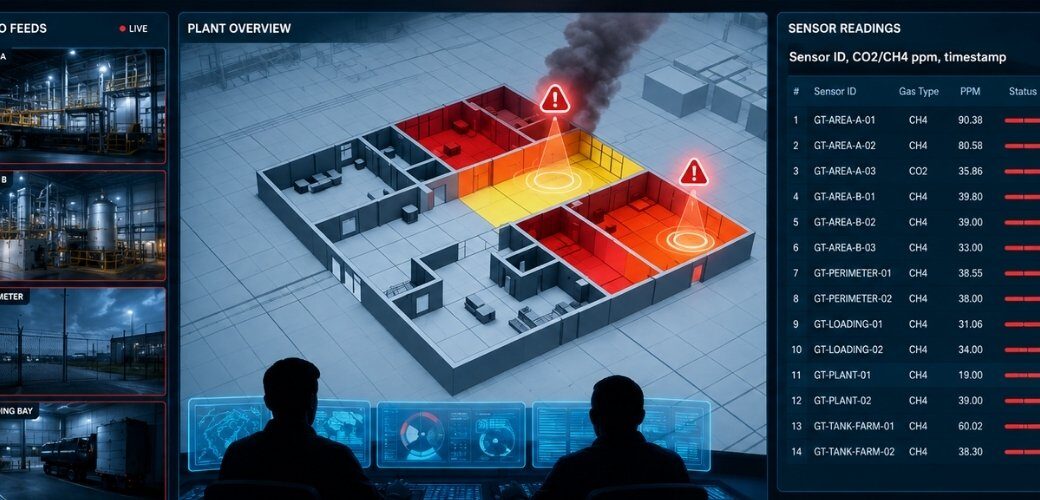
Analytics bring relevant events directly to the attention of operators across distributed locations. Alerts, associated video, and other available information can be presented through centralized dashboards, allowing operators to assess situations remotely and determine the appropriate response.
AI can also help with cross-reference information from different systems. A gas detector alert, for instance, can be assessed alongside video or thermal data to help verify whether there are visible signs of a leak or another abnormal condition. Similarly, a perimeter alert can be evaluated against camera footage to determine whether the event represents unauthorized activity or a lower-priority occurrence.
This approach can also help prioritize incidents based on predefined rules and available context. Rather than treating every alert with the same level of urgency, operators can focus their attention on events that require investigation or immediate action.
Transforming real-time monitoring into proactive risk management
The value of AI – enabled analytics extends beyond identifying individual incidents. By analyzing both real-time and historical operational data, organizations can uncover trends and patterns that may indicate emerging risks. For example:
- Repeated perimeter breaches may identify physical security vulnerabilities.
- Recurring PPE violations may highlight training or compliance issues.
- Frequent environmental alarms could indicate equipment degradation.
- Changes in gas detection patterns may reveal developing operational concerns.
Over time, these insights support a more proactive approach to safety, security, and operational resilience.
Instead of simply responding to individual incidents, organizations can identify underlying issues earlier, implement corrective measures, and reduce the likelihood of future events.
The result is improved risk management, stronger compliance, and greater operational efficiency across critical assets.
Building a scalable and connected security ecosystem
Every oil and gas environment has a different risk profile. A remote pipeline installation may require a different combination of technologies than a refinery, processing plant, storage terminal, or offshore facility.
A unified security architecture enables organizations to scale technologies across diverse environments while maintaining centralized visibility and control.
Integrated solutions can include:
- AI-powered video surveillance
- Thermal imaging systems
- Radar detection technologies
- Gas detection systems
- Perimeter protection
- Access control systems
- Security Operations Center platforms
- Incident management and alarm monitoring solutions
When connected through a centralized platform, these technologies provide a comprehensive view of security and operational risk across multiple locations.
Maintaining performance through managed and lifecycle services
Deploying security technology is only the first step. Long-term effectiveness depends on maintaining systems availability, reliability, and performance.
As remote monitoring environments grow in scale and complexity, organizations need ongoing support to ensure systems remain operational and aligned with evolving requirements.
Maintenance and lifecycle services can provide:
- Preventative maintenance
- Remote system monitoring
- Software and firmware updates
- System health diagnostics
- Technical support and troubleshooting
- Corrective maintenance and repairs
By combining advanced technology with ongoing service support, organizations can maximize system performance while reducing operational risk.
Creating a smarter safety and security strategy
Effective monitoring in the oil and gas sector is not about relying on a single technology. It is about connecting detection, intelligence, and response into a coordinated safety and security ecosystem.
By bringing together centralized, intelligent security capabilities, organizations can move beyond isolated alerts toward a more complete understanding of risk.
Are your security systems working together as one?
Connect intelligent detection, surveillance, analytics, and response technologies to gain a clearer picture of risk and respond faster when it matters most.
Explore Convergint’s integrated oil and gas security solutions